PdO-on-Pd end-to-end example
This reproduces the surface-generation workflow used in Ref. [1] for a simple PdO surface system.
Download tutorial data
Training data
wget https://github.com/nronne/agedi/raw/refs/heads/main/docs/tutorial_data/PdO_training_data.traj
Pd template surface for sampling
wget https://github.com/nronne/agedi/raw/refs/heads/main/docs/tutorial_data/template.traj
Train
For this surface system with Z-confined adsorbates we use the
ConfinedCellPositions noiser, which pairs a
UniformCellConfined prior with a
TruncatedNormal noise distribution.
Using the CLI:
agedi train -t 3 --noisers ConfinedCellPositions --mask MaskFixed --confinement 2 10 PdO_training_data.traj
Notes:
MaskFixedmaps ASEFixAtomsconstraints to the graph mask.Confinement applies to z-coordinates and is useful for slab/surface tasks.
Use
ConfinedCellPositionstogether with--confinementfor surface/slab systems;Positionsfor gas-phase clusters.Outputs are written in
logs/agedi/version_0(or next available version).
This should produce an overview of the architecture like shown below, and then start training.
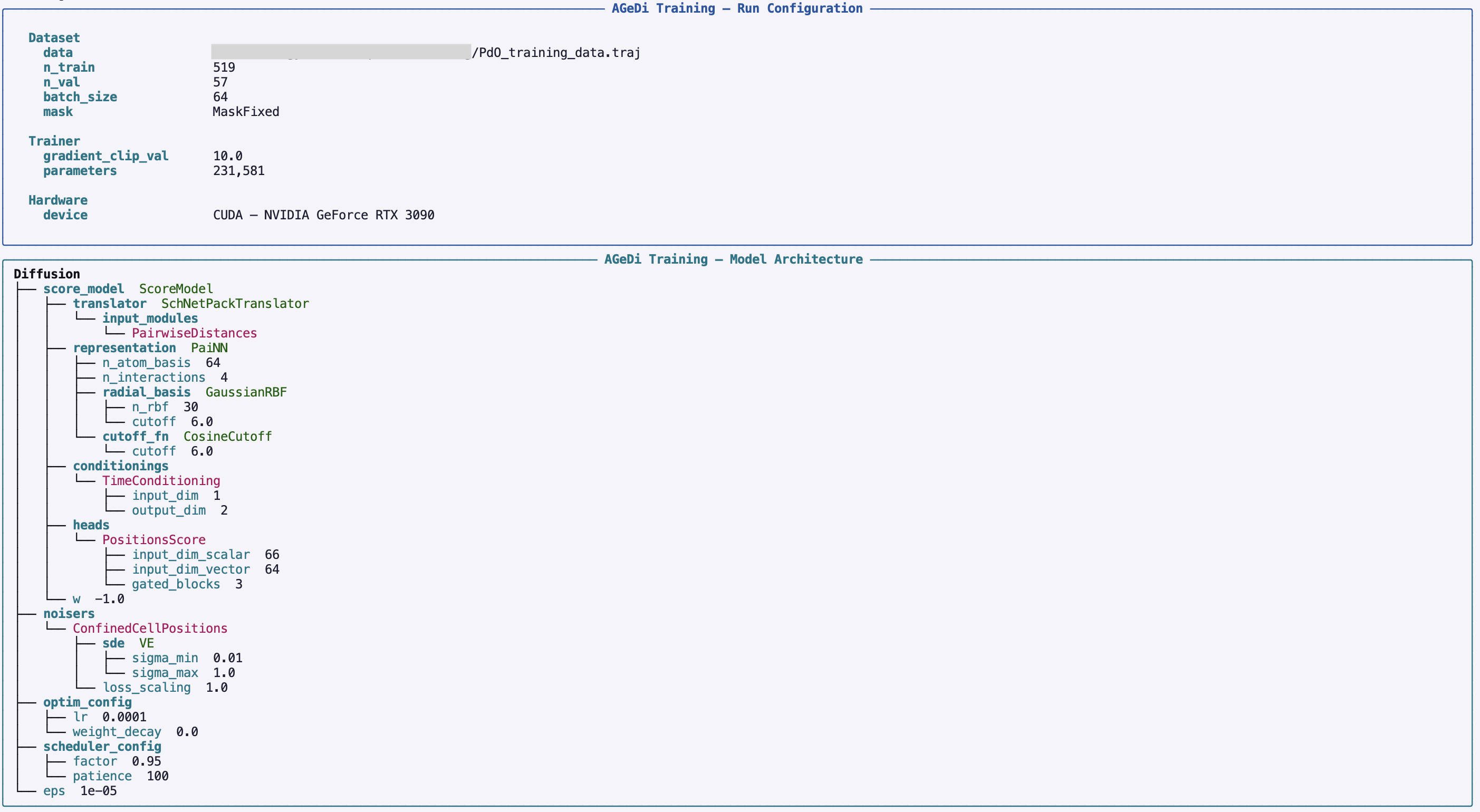
During training, you can inspect the progress using Tensorboard (or WandB).
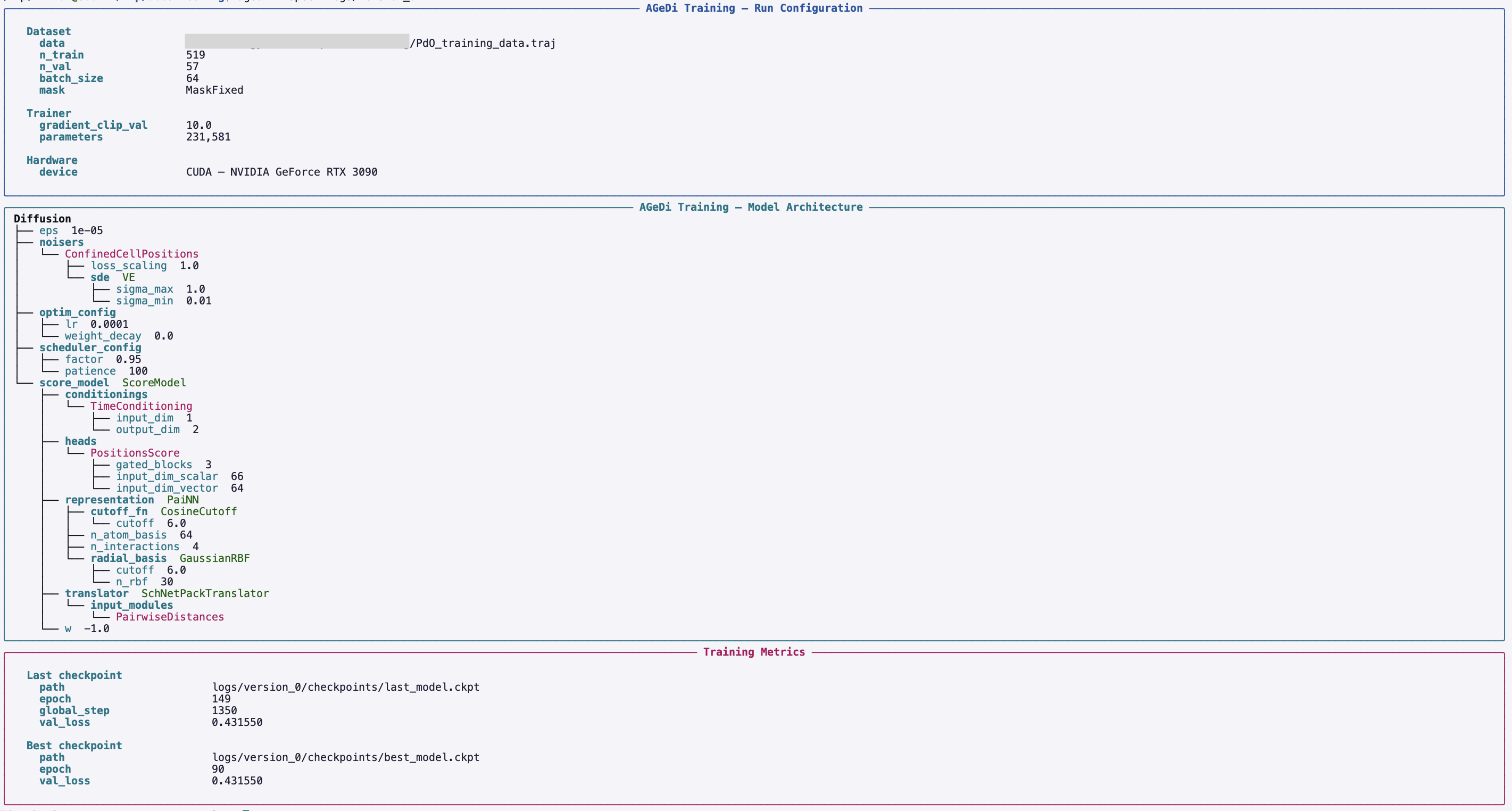
After training you can always inspect the model using
agedi inspect logs/agedi/version_0
This should produce an output similar to the one shown below
Again, we can also use the Python API:
from ase.io import read
from agedi import train_from_atoms

data = read("PdO_training_data.traj", ":")

diffusion, dataset, trainer = train_from_atoms(
    data,
    noisers=("ConfinedCellPositions",),
    mask="MaskFixed",
    confinement=(2.0, 10.0),
    max_time=3,  # hours
    log_dir="logs",
)
Or more explicitly:
from ase.io import read
from agedi import create_diffusion, create_dataset, create_trainer, train

data = read("PdO_training_data.traj", ":")

diffusion = create_diffusion(
    noisers=("ConfinedCellPositions",),
)

dataset = create_dataset(
    data,
    mask="MaskFixed",
    confinement=(2.0, 10.0)
)

trainer = create_trainer(
    max_time=3,  # hours
    log_dir="logs"
)

train(diffusion, dataset, trainer=trainer)
Sample
Using the CLI:
agedi sample logs/agedi/version_0 -f Pd2O2 --template_path template.traj --confinement 2 10
This writes sampled structures to sampled.traj.
Using the Python API:
from ase.io import read, write
from agedi import load_diffusion, sample, AtomsGraph

diffusion = load_diffusion("logs/agedi/version_0")

template = AtomsGraph.from_atoms(read("template.traj"), confinement=(2.0, 10.0))

structures = sample(
    diffusion,
    n_samples=12,
    formula="Pd2O2",
    template=template,
    confinement=(2.0, 10.0),
    steps=500,
)

write("sampled.traj", structures)
References
- [1] N. Rønne, A. Aspuru-Guzik and B. Hammer. Phys. Rev. B 110, 235427 (2024):